The Big 3 for lower back pain are three specific exercises developed by spine biomechanist Dr. Stuart McGill: the McGill Curl-Up, the Bird-Dog, and the Side Bridge. These movements are designed to build spinal stability, reduce mechanical stress on the lumbar spine, and address the core endurance deficits that contribute to persistent lower back pain in adults of all activity levels.For office workers in Sydney sitting for long hours, athletes recovering from lumbar strain, or seniors managing chronic back discomfort, these three exercises offer a structured, evidence-based starting point for pain relief and functional recovery.
The Big 3 Exercises for Lower Back Pain Explained
The McGill Curl-Up, Bird-Dog, and Side Bridge target the three primary muscle groups responsible for spinal stability: the anterior core, the posterior stabilisers, and the lateral trunk muscles. Together, they create a balanced foundation of endurance that protects the lumbar spine during daily movement without placing excessive load on already sensitised spinal structures.
McGill Curl-Up — Spinal Flexor Endurance
The McGill Curl-Up is not a standard sit-up. One knee is bent with the foot flat on the floor while the other leg remains straight. Both hands are placed under the lower back to preserve its natural curve. The head and shoulders lift only slightly off the ground — enough to engage the anterior core without flexing the lumbar spine.This distinction matters. Traditional crunches increase disc pressure significantly. The McGill Curl-Up activates the rectus abdominis and deep stabilisers while keeping spinal compression within safe limits. It builds the endurance needed to support the spine during prolonged sitting, lifting, and bending.
Bird-Dog — Lumbar Stabilisation and Control
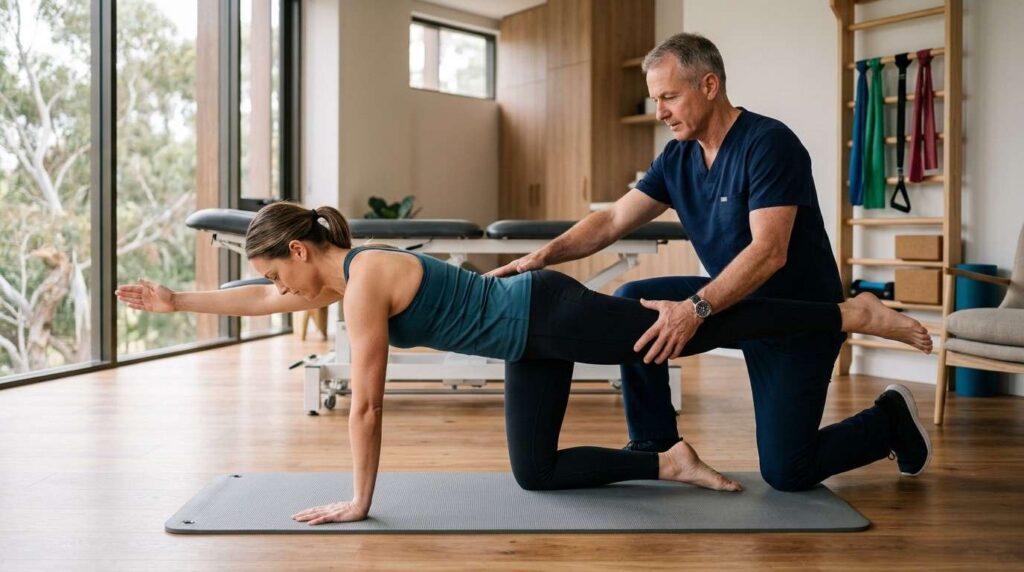
The Bird-Dog begins on all fours with a neutral spine. One arm extends forward while the opposite leg extends back, held for eight to ten seconds before switching sides. The movement trains the posterior chain — specifically the multifidus, erector spinae, and gluteal muscles — to maintain spinal alignment under load.What makes this exercise clinically valuable is its demand for motor control. The lumbar spine must resist rotation and extension simultaneously. For patients with lower back pain linked to poor movement patterns or sedentary postures, the Bird-Dog retrains the neuromuscular system to stabilise the spine automatically during functional tasks.
Side Bridge — Lateral Core Stability
The Side Bridge targets the quadratus lumborum and obliques — the lateral stabilisers that prevent the spine from collapsing sideways under load. Lying on one side with the elbow directly beneath the shoulder, the hips lift off the ground to form a straight line from head to feet.This position creates high muscle activation with minimal spinal compression, making it suitable even during acute pain phases when other exercises are too provocative. Lateral stability is frequently undertrained, yet it plays a critical role in protecting the lumbar spine during walking, carrying, and rotational movements common in both sport and daily life.A structured lower back pain treatment approach considers how exercises like these integrate with clinical assessment, manual therapy, and progressive rehabilitation to address the root cause rather than symptoms alone.
Why These Three Exercises Work for Lower Back Pain
Dr. McGill’s research identified a consistent pattern across lower back pain presentations: the problem is rarely a lack of raw core strength. It is a lack of core endurance — the ability of the spinal muscles to sustain low-level activation over time without fatigue.
The Role of Core Endurance Over Core Strength
High-load exercises like weighted squats or deadlifts demand strength. Daily life demands endurance. Sitting at a desk, standing in a queue, or carrying groceries all require the spine to remain stable for extended periods at low to moderate effort. When the stabilising muscles fatigue, the lumbar spine absorbs compensatory load — and pain follows.The Big 3 train specifically for this endurance demand. They use isometric holds and controlled movement rather than repetition-based loading. This approach reduces cumulative spinal stress while progressively building the muscular stamina the lumbar spine needs to function without pain.For patients whose lower back pain is connected to movement dysfunction or postural fatigue, spinal stabilisation and rehabilitation programs build directly on this endurance foundation with progressive loading and functional movement retraining.
When to Use the Big 3 and When to Seek Professional Care
The Big 3 are appropriate for most non-specific lower back pain presentations — pain without a diagnosed structural cause such as a herniated disc, spinal stenosis, or fracture. They are low-risk, require no equipment, and can be performed at home once technique is established.However, technique matters significantly. Performing these exercises with poor form can reinforce the movement faults that contributed to pain in the first place. A chiropractor or physiotherapist can assess your specific presentation, confirm the exercises are appropriate for your condition, and correct form before you begin independent practice.If your lower back pain is accompanied by leg pain, numbness, tingling, or weakness, the clinical picture is more complex. These symptoms may indicate nerve involvement, and managing nerve-related lower back pain requires a different assessment and treatment pathway before exercise rehabilitation begins.
Conclusion
The Big 3 — McGill Curl-Up, Bird-Dog, and Side Bridge — provide a clinically grounded framework for building the spinal stability that lower back pain most commonly lacks.For adults, professionals, and active individuals in Sydney, these exercises offer a practical, evidence-based tool for reducing pain and restoring function when applied consistently and with correct technique.At Spine and Posture Care Chiropractor Sydney, we assess your specific condition and guide you through the right rehabilitation approach for lasting results.
Frequently Asked Questions
Who developed the Big 3 exercises for lower back pain?
Dr. Stuart McGill, a spine biomechanics professor at the University of Waterloo in Canada, developed the Big 3 through decades of clinical research into lumbar spine mechanics and injury rehabilitation.
How often should you do the Big 3 exercises?
Most protocols recommend performing the Big 3 daily or on most days of the week, using timed holds rather than high repetitions. A chiropractor can tailor the volume and progression to your specific condition.
Can the Big 3 help with sciatica?
The Big 3 may support recovery in some sciatica presentations by reducing lumbar instability. However, nerve-related symptoms require professional assessment first to confirm the exercises are appropriate and safe for your specific diagnosis.
Are the Big 3 exercises safe for seniors?
Yes. The Big 3 are low-load and adaptable, making them suitable for older adults. Modifications can reduce intensity further. A healthcare professional should confirm technique and appropriateness based on individual health status and mobility.
Should you do the Big 3 exercises during a flare-up?
Light versions of the Big 3 can be appropriate during a flare-up because they minimise spinal compression. However, if pain is severe or worsening, stop and consult a chiropractor or healthcare provider before continuing.