
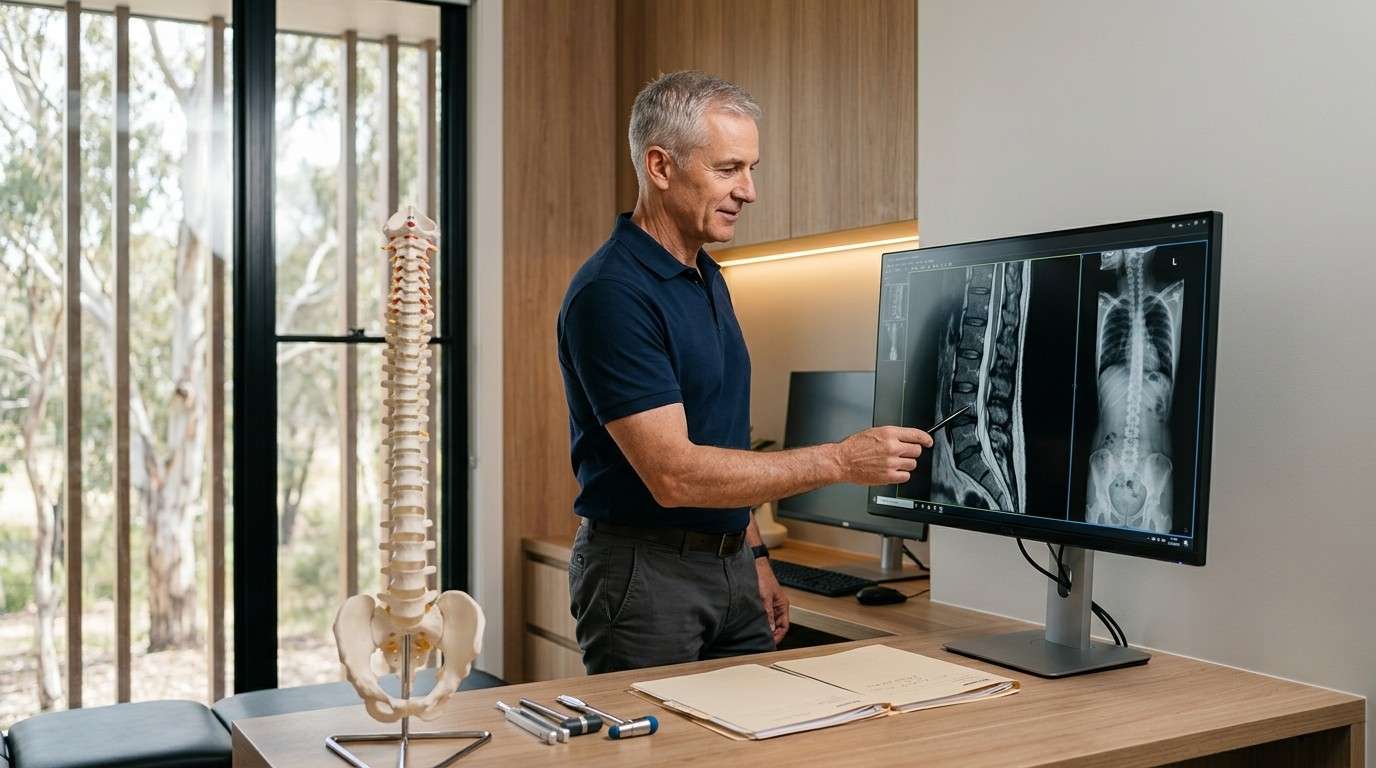
 Night pain that wakes you from sleep or refuses to ease when you lie down is one of the clearest warning signs in spinal health. It tells me something different is happening compared to the ache that builds after a long day at a desk. Most musculoskeletal pain settles with rest. Night pain does not and that distinction matters enormously.
Pain that persists or worsens at night deserves attention. It can point to inflammatory conditions, serious spinal pathology, or referred pain from internal organs none of which improve with positional adjustment alone.
In this article, I cover what separates night pain from ordinary discomfort, the conditions it can signal, what your body does at night that amplifies pain, and when to seek professional assessment.
Most spinal pain is mechanical. It responds to movement, position, and load. You feel it when you sit too long, lift awkwardly, or stand on hard floors all day. And critically it eases when you take the pressure off.
Night pain breaks that pattern. It arrives or intensifies when the mechanical triggers are gone. That is the signal worth paying attention to.
Mechanical pain has a clear cause-and-effect relationship with movement and posture. Non-mechanical pain does not. It persists regardless of what position you adopt, and it often follows a pattern worse in the second half of the night, present on waking, or accompanied by prolonged morning stiffness lasting more than 45 minutes.
Inflammatory back pain is the classic non-mechanical presentation. It improves with movement and worsens with rest the opposite of what most people expect from a spinal complaint.
When you lie flat, spinal compression from gravity reduces. For mechanical pain, that relief is immediate. For inflammatory or pathological pain, lying down removes the distraction of daily activity and the postural loading that was partially masking the symptom.
The result is that pain becomes more noticeable, not less. Some conditions particularly those involving the posterior spinal structures or the sacroiliac joints also load differently in a supine position, which can directly provoke symptoms.
Not every case of night pain points to something serious. But several conditions that require urgent or specialist management present with night pain as a primary feature. Knowing them matters.
Ankylosing spondylitis and other seronegative spondyloarthropathies classically cause inflammatory back pain that is worst in the early morning hours and improves with movement. According to Arthritis Australia, ankylosing spondylitis affects approximately 1 in 200 Australians, with symptoms often beginning before age 45 and frequently misdiagnosed as mechanical back pain for years.
The delay in diagnosis is a real problem. Inflammatory spinal conditions respond to specific medical management and the sooner they are identified, the better the long-term outcome for spinal mobility.
Primary spinal tumours are rare, but spinal metastases are not. Cancers of the breast, lung, prostate, kidney, and thyroid all have a known predilection for spinal metastasis. The pain is typically constant, progressive, unrelated to activity, and present at night.
The Cancer Council Australia identifies unexplained persistent pain particularly at night as one of the key warning signs warranting medical investigation. This is not a condition a chiropractor manages in isolation. It requires immediate medical referral and imaging.
The spine shares neurological territory with several organ systems. Kidney pathology including infection, stones, and tumours frequently refers pain to the lumbar region. Aortic aneurysm, pancreatic disease, and gynaecological conditions can all present as back pain that has no mechanical explanation and does not respond to positional change.
Referred visceral pain tends to be deep, poorly localised, and unaffected by spinal movement. It does not ease with stretching or positional adjustment. That unresponsiveness is itself a diagnostic clue.
There is a meaningful difference between pain that wakes you from sleep and discomfort that comes from sleeping in a poor position. The first is a clinical signal. The second is a mattress problem.
Positional discomfort is localised, eases within minutes of changing position, and does not return once you find a comfortable posture. True night pain persists regardless of position, may worsen in the second half of the night, and is often accompanied by other symptoms fatigue, stiffness, or systemic features like unexplained weight loss.
These questions help clarify the pattern before you see a clinician:
Honest answers to these questions give your clinician a much clearer picture of what they are dealing with.
The biology of nighttime pain is worth understanding. Several physiological processes converge during sleep that can intensify the experience of pain even when the underlying cause is the same as during the day.
Cortisol is a natural anti-inflammatory. Its levels follow a circadian rhythm peaking in the early morning and dropping to their lowest point around midnight. For people with inflammatory conditions, that overnight cortisol trough means inflammation runs relatively unchecked during the hours when they are trying to sleep.
This is one reason inflammatory spinal conditions produce their worst symptoms in the early morning hours rather than the evening. The National Institutes of Health has documented the relationship between circadian cortisol patterns and inflammatory pain amplification, confirming that the overnight period represents a genuine physiological window of increased inflammatory activity.
During the day, cognitive load, movement, and sensory input compete with pain signals for attention. At night, that competition disappears. The nervous system has fewer inputs to process, and pain signals receive proportionally more attention.
This is not imagined pain. It is the same signal, perceived more acutely because the background noise has dropped. For people with central sensitisation a feature of chronic spinal conditions this effect is amplified further.
The urgency of assessment depends on the full symptom picture, not night pain alone. Night pain combined with other features changes the clinical calculus significantly.
Seek same-day or emergency medical assessment for night pain accompanied by any of the following: bladder or bowel dysfunction, progressive lower limb weakness or numbness, saddle anaesthesia, fever, or unexplained significant weight loss. These combinations suggest serious neurological compromise or systemic pathology.
Book a prompt clinical assessment within days, not weeks for night pain that has persisted for more than two weeks without a clear mechanical explanation, night pain in anyone with a history of cancer, or night pain in a person over 50 with no prior history of back problems.
The clinical literature on spinal red flags identifies specific symptom clusters that require urgent triage. These include:
None of these combinations are managed with conservative care alone. They require imaging and medical co-management from the outset.
When a patient presents with night pain, my assessment process is different from a standard mechanical back pain consultation. The goal is not to find the tight muscle or the restricted joint it is to determine whether this pain has a mechanical explanation at all.
A thorough history is the most important diagnostic tool available. I ask about the onset, pattern, behaviour with rest and movement, associated symptoms, and any relevant medical history including prior cancer, inflammatory conditions, or recent infection.
A comprehensive spinal assessment for night pain includes neurological screening, orthopaedic testing, and a careful review of red flag indicators. I assess for signs of nerve root compromise, evaluate spinal mobility patterns, and look for features that are inconsistent with a mechanical explanation.
When the clinical picture raises concern, I refer promptly. Chiropractic care is highly effective for mechanical spinal conditions. For non-mechanical or pathological presentations, the right move is coordinated care working alongside the patient’s GP or specialist to ensure the correct diagnosis is reached and the appropriate management pathway is followed.
Night pain is not a variation of ordinary back pain. It is a distinct clinical presentation that warrants a different level of attention and a more thorough assessment process. The conditions it can signal range from inflammatory arthritis to serious spinal pathology and early identification changes outcomes.
Understanding the difference between positional discomfort and true night pain gives patients the language to describe their symptoms accurately and the confidence to seek help at the right time.
At Spine and Posture Care Chiropractor Sydney, we take night pain seriously from the first consultation. Book an assessment and get a clear picture of what your pain is telling you.
No, not always. Some people experience night pain from poor sleep posture, an unsupportive mattress, or a flare of a known mechanical condition. But night pain that persists regardless of position, wakes you repeatedly, or comes with other symptoms always warrants professional assessment. The pattern matters more than the pain alone.
A disc herniation can cause night pain, particularly when nerve root irritation is significant. The pain tends to follow a dermatomal pattern radiating into the leg or arm and may be aggravated by certain lying positions. It is still a mechanical cause, but the severity and neurological involvement determine how urgently it needs to be assessed.
Inflammatory back pain typically worsens in the second half of the night and into the early morning. It is often accompanied by prolonged stiffness after waking lasting 45 minutes or more and improves with movement rather than rest. That pattern is the opposite of mechanical pain and is a key diagnostic feature clinicians look for.
For most presentations of night pain without red flag features, either is a reasonable starting point. A chiropractor with experience in spinal assessment will screen for red flags and refer to a GP or specialist when the clinical picture warrants it. For night pain with neurological symptoms, fever, or a history of cancer, see a doctor first.
Poor posture contributes to mechanical spinal loading that can cause discomfort, but it rarely produces true night pain that wakes you from sleep. Postural pain typically eases with rest and position change. If your pain is genuinely worse at night and unresponsive to positional adjustment, posture alone is unlikely to be the full explanation.
Do not wait more than two weeks if the pain is persistent, unexplained, or accompanied by any other symptoms. Seek same-day assessment if you have neurological symptoms, fever, or a history of cancer. Early assessment leads to earlier answers and for the conditions that night pain can signal, earlier answers genuinely matter