

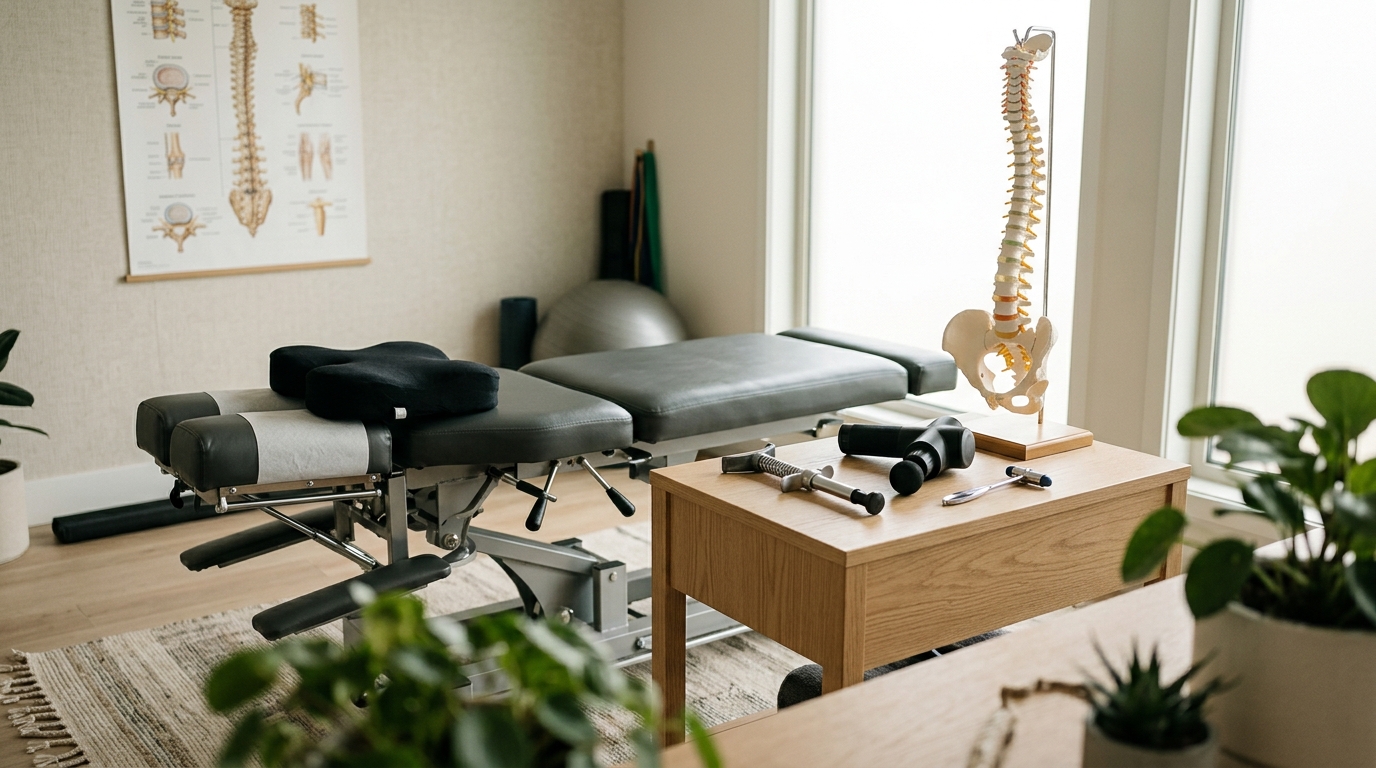
Chiropractic adjustment is a hands-on technique that uses controlled force to restore movement to a restricted spinal joint. I use this definition as the starting point because almost everything else in this guide branches out from it. The core idea barely changes from clinic to clinic — what changes is how that force gets applied.
Table of Contents
ToggleLower back pain, sciatica, and stiff necks don’t respond to a single fix. And most patients I see in Sydney have already tried something else before landing on a chiropractic table, so they usually want to know what’s actually happening under their skin.
This guide covers the science and mechanics of an adjustment, the main hands-on and instrument-based techniques we use, specialised approaches for discs, sciatica, and chronic pain, and what to expect, safety considerations, and keeping results long-term.
What Chiropractic Adjustments Are and How They Work
An adjustment applies a quick, controlled force to a joint that has lost some of its normal range of motion. That’s the mechanical part. The clinical part is figuring out which joint is restricted and why.
I look at posture, movement patterns, and pain location before I touch a spine. A restricted joint in the lower back doesn’t always cause pain exactly where it sits — it can refer pain down through the hip or leg, which is one reason sciatica gets misdiagnosed so often.
The Science Behind Spinal Manipulation
Spinal manipulation research has grown considerably over the past decade. The National Center for Complementary and Integrative Health reports that spinal manipulation can provide modest short-term relief for acute low back pain, comparable to other standard treatments.
The audible “crack” that happens during an adjustment is gas releasing from the joint fluid, not bone grinding on bone. I explain this to almost every new patient because it’s the single biggest misconception I run into.
What Happens During an Adjustment
I assess the joint, position the patient, and apply a short, targeted thrust or pressure — the exact method depends on the technique. Some adjustments happen with my hands directly on the spine. Others use a small handheld instrument instead.
The sensation is usually a release of pressure rather than pain. Most patients feel looser within minutes, though the full effect builds over several sessions.
Diversified Technique — The Foundation of Modern Chiropractic Care
Diversified technique is a manual chiropractic method that uses a high-velocity, low-amplitude thrust to restore joint motion. It’s the most widely taught and widely used approach in chiropractic education, and it forms the backbone of most treatment plans I build.
This technique treats the spine segment by segment. I find the specific vertebra that’s restricted, position the body to isolate that joint, then deliver a fast, shallow thrust that moves the joint just past its current limit.
It works well across a broad range of conditions — general stiffness, mechanical back pain, joint restrictions in the neck and mid-back. Because it’s adaptable, I use it as a starting point before layering in more specific techniques.
Gonstead Technique for Precise Spinal Correction
The Gonstead technique is a chiropractic method built around detailed spinal analysis before any adjustment happens. It relies on X-ray review, palpation, and observation of skin temperature changes along the spine to pinpoint exactly which vertebra needs correction.
I find this approach particularly useful for patients with a clear, localised problem — a single disc level causing sciatica, for example. The adjustment itself uses a specific hand contact and a precise line of force, delivered without twisting the spine into a rotated position first.
Gonstead practitioners tend to treat one segment with real precision rather than adjusting broadly. That precision takes longer to assess but often produces a more targeted correction for chronic, well-defined issues.
Activator Method — Low-Force Instrument Adjusting
Activator method uses a small spring-loaded instrument to deliver a quick, low-force impulse to a specific spinal segment. It replaces the manual thrust with a mechanical one, which changes who this technique suits.
I reach for the Activator with older patients, anyone with osteoporosis, or people who feel anxious about manual manipulation. The instrument delivers a controlled, consistent force every time, which takes some of the unpredictability out of the adjustment.
It doesn’t produce the audible crack most people associate with chiropractic care. Some patients actually prefer that — the adjustment feels more like a tap than a manipulation.
Spinal Decompression and Flexion-Distraction for Disc Conditions
Flexion-distraction is a technique that gently stretches and flexes the spine using a specialised table, taking pressure off compressed discs and nerves. I use this specifically for disc-related pain, because it creates space in the disc space rather than forcing a joint through a thrust.
Patients with a slipped disc or sciatica often can’t tolerate a standard high-velocity adjustment comfortably. The table does the work slowly — a rhythmic stretching motion that reduces pressure on the nerve root without the sudden movement.
A 2023 review published in the Journal of Manipulative and Physiological Therapeutics found flexion-distraction therapy associated with meaningful reductions in leg pain for patients with lumbar disc herniation over a course of treatment.
I typically pair this with soft tissue work, since the surrounding muscles tend to guard and tighten around an irritated disc.
Soft Tissue and Muscle-Focused Techniques
Adjustments address joints. Soft tissue techniques address the muscles, tendons, and fascia surrounding those joints — and skipping this half of treatment leaves a lot of pain on the table, literally.
Muscle tightness pulls joints out of alignment just as much as a stuck joint creates muscle tension. Treating both together tends to hold results longer than adjusting alone.
Myofascial Release
Myofascial release is a manual technique that applies sustained pressure to tight fascia to reduce restriction and improve tissue mobility. I use slow, direct pressure over tight bands of tissue, holding until I feel the tissue soften and release.
This works particularly well for chronic tension patterns — the kind that builds up in the neck and shoulders from years at a desk.
Trigger Point Therapy
Trigger point therapy targets specific hyperirritable spots in a muscle that refer pain to other areas of the body. A trigger point in the upper trapezius, for example, commonly refers pain up into the head, which is why it gets mistaken for a tension headache.
I apply direct pressure to the point until the tension eases, sometimes combined with stretching afterward. Patients are often surprised that pressing on their shoulder relieves a headache they’ve had for days.
Choosing the Right Technique for Your Condition
No single technique fits every condition, and a good treatment plan usually blends two or three approaches based on what’s actually driving the pain. I build every plan around the assessment findings, not a default protocol.
Techniques for Lower Back Pain and Sciatica
Lower back pain responds well to diversified technique for general stiffness, Gonstead for a precisely located segmental issue, and flexion-distraction when a disc is involved. Sciatica specifically tends to need decompression-based approaches, since nerve compression rarely resolves with a thrust alone.
The American Chiropractic Association notes that combined manual therapy and exercise-based rehabilitation produces the strongest outcomes for chronic low back pain, rather than manipulation alone.
Techniques for Neck Pain and Headaches
Neck pain and cervicogenic headaches usually call for a gentler touch — lower-force adjustments, Activator method for sensitive areas, and trigger point work through the upper trapezius and suboccipital muscles. The neck has less soft tissue protecting it than the lower back, so I’m more conservative with force here.
Posture correction plays a bigger role in neck cases than in most lower back cases. A forward head posture from screen use keeps reloading the same joints no matter how well an adjustment goes.
What to Expect in Your First Chiropractic Adjustment
The first visit starts with a full history and physical assessment before any hands-on treatment happens. I want to understand the pain pattern, previous injuries, and what daily movements aggravate the symptoms.
Most first adjustments feel like pressure and release rather than pain. Some patients feel immediate relief. Others notice the benefit build gradually over the following days as inflammation settles and movement improves.
I always explain what I’m doing and why before I do it. There shouldn’t be any surprises during a session — informed patients tend to relax more, and a relaxed muscle responds better to treatment.
Safety, Side Effects, and Who Should Avoid Certain Techniques
Chiropractic adjustment carries a well-documented safety profile when performed by a trained practitioner on an appropriately screened patient. Mild soreness or fatigue after a session is the most common side effect, and it typically resolves within a day or two.
A large-scale study published by Harvard Health Publishing found serious adverse events from spinal manipulation to be rare, with most complications linked to pre-existing conditions that weren’t screened beforehand.
Certain groups need modified techniques or should avoid manual manipulation altogether. Severe osteoporosis, spinal fractures, certain cancers, and specific vascular conditions all change what’s appropriate — which is exactly why a thorough intake matters before the first adjustment.
I screen for these red flags on every new patient, no exceptions. It’s not overcaution. It’s the difference between a technique helping and a technique causing harm.
How Adjustment Results Are Maintained Long-Term
A single adjustment rarely fixes a problem that took months or years to develop. Results hold longer when the joint gets time to stabilise in its corrected position and the surrounding muscles get strong enough to support it.
I build rehabilitation exercises into most treatment plans for exactly this reason. Posture correction, strengthening, and mobility work all reduce how quickly a joint drifts back into its old restricted pattern.
Spacing between visits usually widens as symptoms improve — frequent early on, then tapering to maintenance visits. That tapering isn’t arbitrary. It tracks how well the body is holding the correction between sessions.
Conclusion
Chiropractic care spans a wide range of techniques, from high-velocity manual thrusts to gentle instrument-based methods and disc-focused decompression. Each one solves a different mechanical problem, and matching the right technique to the right condition changes the outcome.
Lasting relief comes from more than a single adjustment. It comes from an accurate diagnosis, the right technique, and a plan that addresses posture and strength alongside the joint itself.
We build every treatment plan around your specific condition and goals. Book an assessment with our team to find out which techniques fit your body and your recovery.
Frequently Asked Questions
Does chiropractic adjustment hurt?
Adjustment itself is rarely painful. Most patients feel pressure followed by a release, and any soreness afterward is mild and resolves within a day or two.
How many sessions does it take to see results?
Most patients notice improvement within three to six sessions, though chronic conditions often need a longer course of care to stabilise fully.
Is the cracking sound during an adjustment dangerous?
No. That sound is gas releasing from the joint fluid, not bone damage, and it has no bearing on how effective the adjustment was.
What’s the difference between Gonstead and Diversified technique?
Gonstead targets one specific segment using detailed analysis, while Diversified technique treats the spine more broadly across multiple segments in a single session.
Can chiropractic care help a slipped disc?
Flexion-distraction and spinal decompression techniques specifically reduce pressure on a herniated disc and often ease nerve-related leg pain over a course of treatment.
Is chiropractic adjustment safe for older adults?
Yes, with modified technique. Low-force methods like the Activator are commonly used for older patients or those with reduced bone density.
Why do I need multiple techniques instead of just one?
Different structures — joints, muscles, and discs — respond to different mechanical approaches, so a combined plan usually addresses the full problem rather than one part of it.
How often should I get adjusted to maintain results?
Frequency tapers as symptoms improve. Most patients move from weekly visits early in care to monthly or as-needed maintenance once the spine stabilises.