
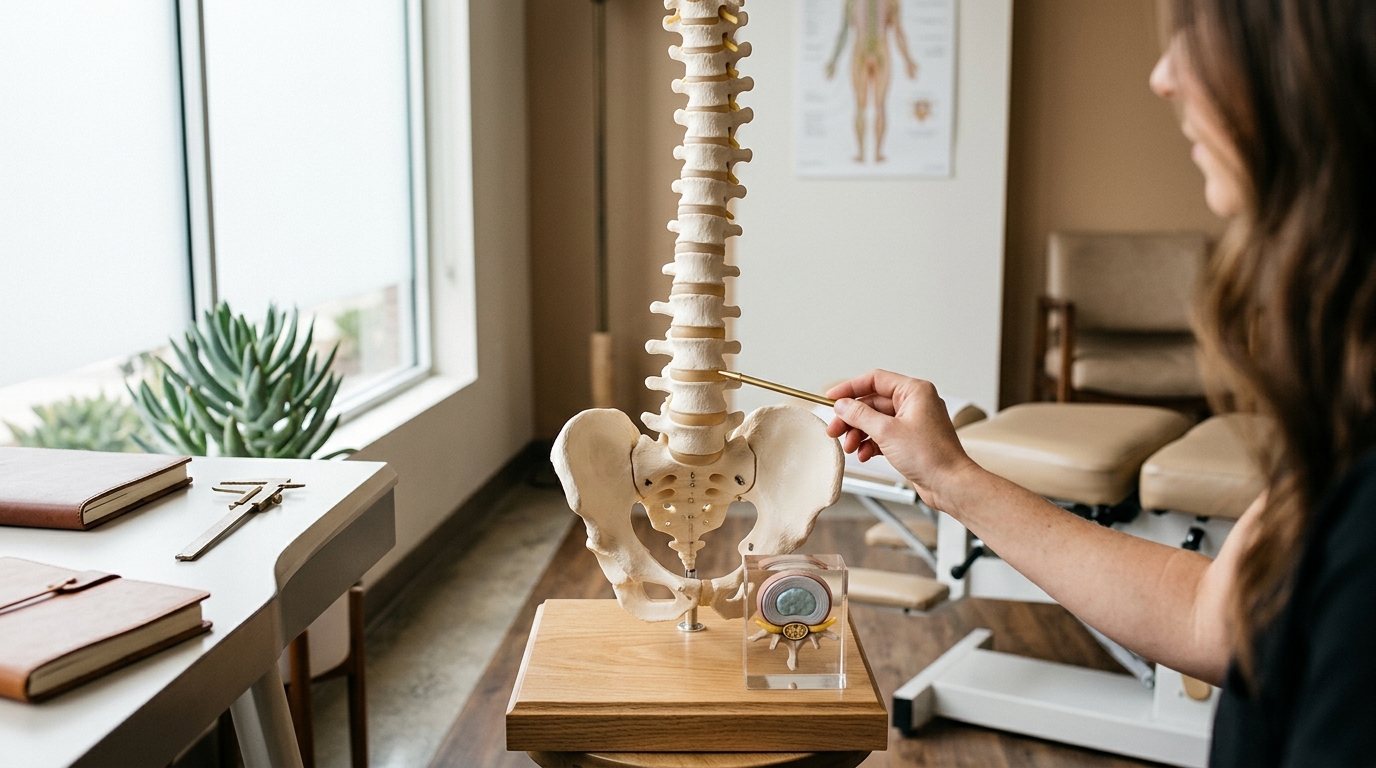
Your spine is a stack of 33 vertebrae working together to support your entire body while protecting the nervous system running through its core. I explain how this structure actually works, because understanding it changes how you think about pain, posture, and movement.
Table of Contents
ToggleMost people never think about their spine until something hurts. Sitting for hours, carrying heavy bags, sleeping awkwardly — it all adds up on structures never designed for that kind of strain.
I cover the structural foundations of the spine and nervous system, the muscles and joints that keep everything moving, the conditions that develop when things go wrong, and the practical steps that protect this system for years to come.
How the Spine Is Structured: Regions, Curves, and Vertebrae
The spine is a stack of individual bones called vertebrae, separated by cushioning discs and held together by ligaments and muscles. It runs from the base of the skull down to the pelvis, and every region along that path has a distinct job.
The Cervical, Thoracic, Lumbar, Sacral, and Coccygeal Regions
The cervical spine is a region of the spine that consists of seven vertebrae supporting the head and enabling neck rotation. It sits at the top and carries the full weight of the skull, roughly 4.5 to 5 kilograms, which is a lot of load for such a mobile section.
Below that sits the thoracic spine, twelve vertebrae that anchor the rib cage and protect the heart and lungs. This region moves less than the neck or lower back, and that’s by design — stability matters more here than flexibility.
The lumbar spine carries five vertebrae and bears most of the body’s weight during standing, lifting, and bending. I see more issues originate here than anywhere else in the spine, simply because of the mechanical load it absorbs daily.
Beneath the lumbar region, the sacrum and coccyx form the base of the spine. The sacrum connects to the pelvis, and the coccyx, the tailbone, anchors several ligaments and muscles involved in movement and support.
Why the Spine’s Natural Curves Matter
A healthy spine isn’t straight. It curves in an S-shape, with the cervical and lumbar regions curving inward and the thoracic region curving outward.
These curves distribute mechanical stress evenly across the entire structure. Flatten them out or exaggerate them, and the load stops being shared properly — certain segments start absorbing far more force than they’re built for.
That imbalance is often where pain starts. A forward head posture flattens the cervical curve, and a slouched sitting position can exaggerate the thoracic curve, both of which shift stress onto joints and discs that weren’t designed to carry it alone.
Intervertebral Discs and How They Support Movement
Between each pair of vertebrae sits a disc that acts as both a shock absorber and a spacer. Without these discs, the vertebrae would grind directly against each other with every step, twist, and bend.
Disc Structure: Annulus Fibrosus and Nucleus Pulposus
An intervertebral disc is a cartilaginous structure that cushions the vertebrae and allows controlled spinal movement. It has two main parts working together as a unit.
The annulus fibrosus is the tough, fibrous outer ring that contains and protects the disc’s center. Inside that ring sits the nucleus pulposus, a gel-like core that shifts slightly with movement, distributing pressure as the spine bends and rotates.
This design lets the spine flex, extend, and twist without the vertebrae colliding. It’s a clever piece of engineering, and it holds up well under normal use.
How Discs Wear Down Over Time
Discs lose water content as we age, which reduces their height and shock-absorbing capacity. This is a normal part of aging, but it doesn’t happen at the same rate for everyone.
Repetitive poor posture, heavy lifting with improper form, and prolonged sitting all accelerate this wear. The National Institute of Arthritis and Musculoskeletal and Skin Diseases notes that disc degeneration is a leading structural contributor to chronic back pain across adult populations.
When the outer ring weakens enough, the inner gel can push outward or through it entirely. That’s the mechanical basis for a slipped or herniated disc, something I cover in more detail later in this guide.
The Spinal Cord and Nervous System Connection
The spine isn’t just a stack of bones — it’s a protective housing for the spinal cord, the main communication pathway between your brain and the rest of your body.
How Nerve Roots Exit the Spine
At each vertebral level, nerve roots branch off the spinal cord and exit through small openings called foramina. These nerve roots then travel to specific muscles, organs, and skin regions, carrying signals in both directions.
This is why spinal issues so often show up as symptoms somewhere else entirely. A problem at one vertebral level can affect sensation or movement in an arm, a leg, or even internal organ function, depending on which nerve root gets involved.
Why Nerve Compression Causes Pain Elsewhere in the Body
Nerve compression happens when a disc bulges, a joint swells, or surrounding tissue thickens enough to press on a nerve root. The result is pain, numbness, or weakness that follows the nerve’s path rather than staying at the compression site.
Sciatica is the clearest example of this. Pressure on the sciatic nerve in the lower back can send pain shooting down through the buttock, thigh, and calf, even though the actual problem sits at the spine.
That disconnect between symptom location and root cause is exactly why self-diagnosing spinal pain is so unreliable. A thorough assessment traces the symptom back to where it actually starts.
Muscles and Ligaments That Stabilize the Spine
Bones and discs give the spine its structure, but muscles and ligaments are what keep it upright, stable, and controlled during movement.
Core and Deep Stabilizing Muscles
The deep stabilizing muscles, including the multifidus and transverse abdominis, work below the surface to control small movements between individual vertebrae. They don’t get the attention that visible abdominal muscles do, but they matter more for spinal health.
Weakness in these deep stabilizers is common in people who sit for long stretches without moving. And when they weaken, larger, more superficial muscles start compensating, which often leads to tension, stiffness, and eventually pain.
Ligaments and Their Role in Spinal Support
Ligaments connect bone to bone and limit excessive movement at each spinal joint. The anterior and posterior longitudinal ligaments run the full length of the spine, reinforcing stability at every vertebral level.
These structures don’t have much elasticity by design. That’s the point — too much give in a ligament means less control over how far a joint can move, which raises injury risk during sudden or awkward motions.
Joints of the Musculoskeletal System and Their Role in Motion
Every vertebra connects to the ones above and below it through small joints that control how much the spine can bend, twist, and extend.
Facet Joints and Spinal Mobility
Facet joints are the small paired joints located at the back of each vertebra, guiding the direction and range of spinal movement. They’re synovial joints, meaning they contain lubricating fluid similar to joints in the knee or shoulder.
These joints can develop arthritis-like changes over time, particularly under repetitive stress or after injury. When that happens, movement in that spinal segment becomes restricted, and surrounding muscles often tighten in response.
Major Peripheral Joints Affected by Posture and Alignment
Spinal alignment doesn’t stay isolated to the back. Hip, knee, and shoulder joints all adjust their mechanics based on how the spine is positioned during standing and walking.
A pelvis that tilts forward from tight hip flexors changes how weight distributes through the knees. Rounded shoulders from prolonged desk work shift the load-bearing pattern in the shoulder joints themselves.
Posture and Spinal Alignment Explained
Posture is simply the position your skeletal structure holds during sitting, standing, and movement. It sounds simple, but the mechanical consequences of poor posture compound over years.
What Good Posture Looks Like Structurally
Good posture keeps the ears, shoulders, and hips roughly aligned in a vertical line when viewed from the side. This alignment lets the spine’s natural curves do their job, distributing load evenly rather than concentrating it at specific points.
I look for this alignment during assessments because it tells me a lot about where mechanical stress is likely accumulating, even before a patient describes any specific pain.
How Poor Posture Reshapes the Spine Over Time
Sustained poor posture doesn’t just cause temporary discomfort — it gradually reshapes soft tissue and joint mechanics. Muscles on one side shorten while muscles on the opposing side lengthen and weaken, creating an imbalance that reinforces itself.
Forward head posture, common among people who spend hours looking at screens, adds significant load to the cervical spine. Research published by Harvard Health Publishing indicates the effective weight on the neck can multiply several times over as the head tilts forward from a neutral position.
Common Musculoskeletal Conditions Linked to Spinal Anatomy
Understanding spinal structure makes it much easier to understand why specific conditions develop where they do.
Slipped and Herniated Discs
A herniated disc is a condition where the inner nucleus pulposus pushes through a tear in the outer annulus fibrosus. This can happen suddenly from a specific injury or gradually from repeated wear.
Symptoms depend heavily on location and severity. A lumbar disc herniation often causes lower back pain with radiating leg symptoms, while a cervical herniation tends to affect the neck, shoulder, and arm instead.
Sciatica and Nerve-Related Pain
Sciatica describes pain that follows the path of the sciatic nerve, usually triggered by compression somewhere along the lower spine. It’s a symptom pattern rather than a standalone diagnosis, which means the actual cause still needs identifying.
I’ve seen sciatica stem from disc herniation, from muscle tightness pressing on the nerve, and from joint changes narrowing the space the nerve travels through. Each cause needs a different treatment approach entirely.
Chronic Neck and Lower Back Pain
Chronic spinal pain, lasting longer than three months, often traces back to a combination of structural, muscular, and postural factors rather than one single cause. The World Health Organization reports low back pain as the single leading cause of disability worldwide, affecting hundreds of millions of people at any given time.
That scale tells you something important. This isn’t a rare or unusual problem — it’s an extremely common consequence of how modern life interacts with a structure built for a different kind of movement pattern.
How Age, Lifestyle, and Occupation Affect Spinal Health
Spinal anatomy doesn’t exist in isolation from the way people actually live and work. Daily habits shape structural health as much as genetics do.
Desk Work, Screen Time, and Sedentary Strain
Prolonged sitting increases pressure on lumbar discs compared to standing, and that pressure compounds hour after hour at a desk. Add a forward head posture from screen use, and the cervical spine picks up additional strain on top of it.
I see this pattern constantly in office workers and students. The body wasn’t built to hold one static position for eight or more hours a day, and the spine is usually the first structure to register the complaint.
Age-Related Degeneration and Wear
Natural degeneration affects discs, joints, and ligaments as part of normal aging, typically becoming more noticeable from the mid-thirties onward. This doesn’t mean pain is inevitable — many people with visible degenerative changes on imaging report no symptoms at all.
What matters more than age alone is how well surrounding muscles compensate for that gradual structural change. Strong, well-conditioned support muscles can carry a degenerating spine through decades of active life without significant pain.
How Chiropractic Assessment Maps to Spinal Anatomy
A proper assessment isn’t guesswork. It’s a structured process of tracing symptoms back to the specific anatomical structures actually causing them.
What a Spinal Assessment Actually Evaluates
We evaluate posture, range of motion, joint mobility, muscle tone, and neurological signs during a comprehensive assessment. Each of these tells a different part of the anatomical story, and together they build a complete picture.
Range of motion testing, for example, reveals which spinal segments move freely and which feel restricted. Neurological testing checks whether nerve signals are transmitting normally along their expected pathways.
Connecting Symptoms Back to Structural Causes
Two patients with identical lower back pain can have completely different underlying causes. One might have a facet joint restriction, another a disc issue, another pure muscular tension from postural habits.
That’s exactly why we don’t treat symptoms in isolation. We connect the reported pain back to the specific anatomical structure generating it, because treatment only works when it targets the actual source.
Practical Steps to Support Spinal and Musculoskeletal Health
Understanding anatomy is genuinely useful because it points toward specific, practical actions rather than vague advice.
Daily Habits That Protect Spinal Structure
Movement breaks every 30 to 45 minutes reduce the sustained pressure that builds up on lumbar discs during long sitting periods. Standing, walking briefly, and changing position gives compressed structures a chance to recover.
Strengthening the deep core muscles improves the spine’s ability to stabilize itself during everyday movement. And paying attention to how you lift, bend, and carry things prevents a huge share of the mechanical injuries I see regularly.
Sleep position matters too. A supportive mattress and proper pillow height keep the cervical and lumbar curves in a more neutral position through the night.
When Structural Changes Need Professional Care
Pain lasting more than a few days, numbness or tingling that spreads, or any weakness in a limb are signs that professional evaluation makes sense. These symptoms suggest something beyond simple muscular fatigue.
We assess exactly what’s happening structurally and build a treatment plan around the specific cause. Getting the right diagnosis early tends to shorten recovery time considerably compared to waiting and hoping symptoms resolve alone.
Conclusion
The spine is a genuinely elegant structure, one where bones, discs, nerves, muscles, and joints all depend on each other to function well. Pain rarely comes from nowhere. It comes from somewhere specific within this connected system.
Understanding your own anatomy changes how you approach prevention and recovery. It shifts you from guessing about symptoms toward addressing actual causes.
We build every treatment plan around your specific anatomical picture. Reach out to Spine and Posture Care Chiropractor Sydney and let’s find out exactly what your spine needs.
Frequently Asked Questions
How many vertebrae are in the human spine?
The human spine has 33 vertebrae total, divided across the cervical, thoracic, lumbar, sacral, and coccygeal regions. Not all of them move independently, since the sacral and coccygeal vertebrae fuse together in adults.
What is the difference between a slipped disc and a herniated disc?
These terms actually describe the same condition. Both refer to the inner disc material pushing through a weakened outer layer, pressing on nearby nerves.
Why does lower back pain sometimes cause leg pain too?
Lower back pain radiates into the leg when a compressed nerve root in the lumbar spine sends pain signals along its full pathway. This pattern, often called sciatica, means the actual problem sits at the spine even though the pain feels like it’s in the leg.
Can poor posture actually change my spine’s structure?
Yes, sustained poor posture gradually reshapes muscle length, joint mechanics, and even spinal curvature over months and years. The earlier these patterns get addressed, the easier they are to correct.
What causes the spine’s discs to wear down?
Discs lose water content and height naturally with age, and that process speeds up with repetitive strain, poor lifting habits, and prolonged sitting. Genetics also plays a meaningful role in how quickly this wear develops.
Is back pain always related to a spinal problem?
Not always — muscular tension, joint restrictions, and postural habits can all cause significant back pain without any disc or nerve involvement. That’s exactly why a proper assessment matters before assuming the worst.
How does the nervous system connect to spinal health?
The spinal cord runs through the vertebral column, with nerve roots branching out at each level to reach muscles, skin, and organs throughout the body. Any compression along this pathway can create symptoms far from the spine itself.
At what age does spinal degeneration typically start?
Degenerative changes often become noticeable from the mid-thirties onward, though the rate varies significantly between individuals. Lifestyle factors influence this timeline more than most people realize.
Can strengthening muscles really help protect my spine?
Yes, strong deep stabilizing muscles significantly improve the spine’s ability to handle daily mechanical stress and reduce injury risk. This is one of the most effective long-term strategies for supporting spinal health.