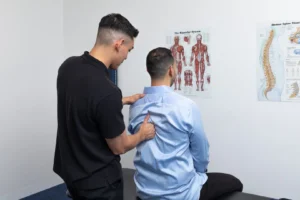

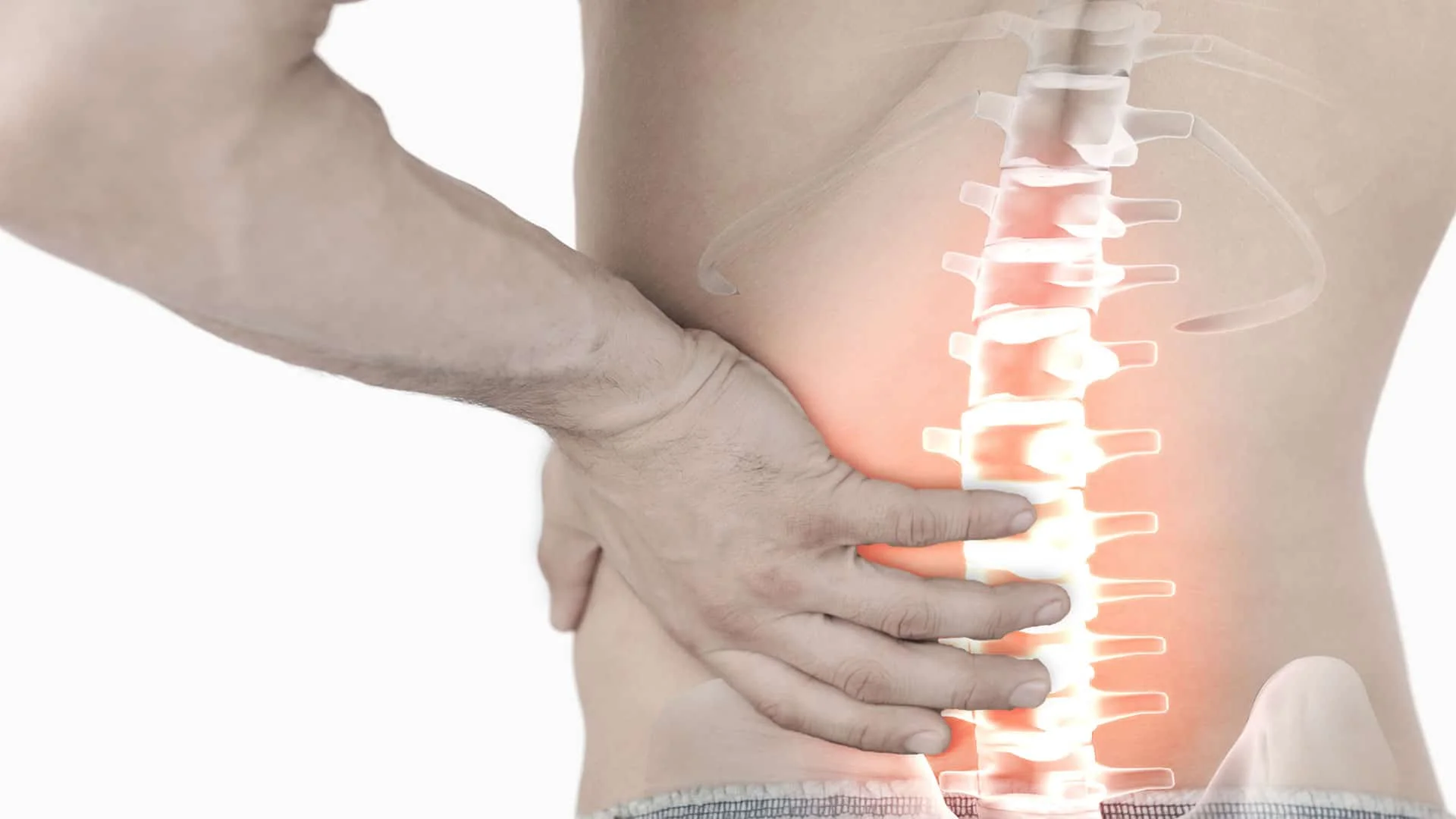
Back pain after driving in Sydney traffic is one of the most common complaints seen at lower back pain treatment in Sydney clinics across the CBD. Most commuters assume it is simply from sitting too long. The real reason is more specific than that, and understanding it makes it far easier to fix.
Spine and Posture Care works with Sydney CBD commuters daily, and the pattern is consistent: the type of driving this city demands does something to the spine that a long country drive rarely does. This guide explains exactly what that is, why Sydney’s roads make it worse, and what to do about it.
Sydney Traffic Is Not Just Frustrating. It Is Hard on Your Spine
The numbers behind the daily grind
Sydney commuters are not imagining it. The TomTom Traffic Index recorded that Sydney drivers lost 93 hours to traffic congestion in 2025. The average car commute in Sydney runs to around 45 minutes each way, covering roughly 31.7 kilometres. On peak-hour corridors like the Sydney Harbour Bridge approach ramps and the western distributor, speeds regularly drop to around 23 km/h.
That means the typical Sydney CBD worker spends roughly 90 minutes a day in the car. Over a five-day working week that is 7.5 hours of exposure. Over a year it is close to 375 hours. The spine feels every one of them.
Why stop-start is worse than long-distance driving
Most people assume a long motorway drive is harder on the back than a short city commute. The opposite is often true. On a steady motorway at 100 km/h, the body settles into a relatively consistent position. Muscles find a holding pattern. The spine loads evenly.
In stop-start Sydney traffic, the body never settles. Every brake event triggers a subtle forward lean and a low-grade bracing response in the core and paraspinal muscles. Every acceleration from a standstill shifts weight through the hips.
Every lane change involves a rotational micro-load through the lumbar spine. These movements are small but relentless. Over a 45-minute crawl down Parramatta Road or Military Road, the cumulative load on the lumbar spine is considerably higher than the same time spent on the motorway.
What Actually Happens to Your Back During a Sydney Commute
Disc pressure in a seated position
The intervertebral discs in the lumbar spine act as shock absorbers between the vertebrae. In an upright standing position, disc pressure across the lower lumbar levels sits at a moderate baseline. In a seated position, that pressure increases by roughly 40 per cent. In a slouched seated position, which is the position most Sydney drivers gradually drift into after the first ten minutes of commuting, pressure increases further still.
Sustained elevated disc pressure during a 45-minute commute compresses the fluid-filled nucleus of the disc. Over time, with repeated daily loading, this contributes to disc dehydration and gradual height loss. These changes show up in scans of regular commuters in their 30s and 40s.
Hip flexor tightening and lumbar flattening
The hip flexors, primarily the iliopsoas group, connect the lumbar vertebrae to the femur. In a seated position they are shortened and contracted. During a long commute they stay that way. When a driver finally stands and walks to the office, the hip flexors have adapted to that shortened length. They then pull the pelvis into an anterior tilt, which compresses the lumbar facet joints.
The lumbar spine has a natural inward curve. When the hip flexors tighten and pull the pelvis forward, that curve either exaggerates or, in the more common pattern for desk workers, flattens because the car seat pushes the pelvis into a posterior tilt. Either way, the lumbar spine is loaded asymmetrically. By the time a Sydney commuter sits down at their desk, the damage is already underway and the day has barely started.
The bracing reflex in stop-start traffic
This is the mechanism no other guide explains. Every time a vehicle brakes suddenly in front, the driver reacts by bracing. The shoulders tighten, the hands grip the wheel, and the deep stabilising muscles of the trunk contract. This response is involuntary and appropriate for genuine emergencies. In Sydney peak-hour traffic it happens constantly, sometimes dozens of times per commute.
Each bracing event loads the multifidus and erector spinae muscles asymmetrically. The driver is rarely perfectly centred when it happens. They may be mid-lane-change, checking a mirror, or leaning into a merge gap. The cumulative effect of dozens of asymmetric micro-brace events across a 45-minute commute is significant muscular fatigue and joint loading. The body does not have time to recover before the return trip.
The Six Reasons Sydney Commuters Develop Back Pain Behind the Wheel
The biomechanics in Section 2 describe what happens to every driver. The six factors below determine which Sydney commuters end up with persistent back pain and which ones manage the same commute without issue. Spine and Posture Care assesses all six as part of every initial consultation for driving-related back pain.
Poor lumbar support and seat position
The lumbar region of most standard car seats does not naturally support the inward curve of the lower spine. Without active lumbar support, the lower back rounds into the seatback and the natural lumbar lordosis is lost. The muscles that would normally maintain that curve, the multifidus and deep erectors, disengage. The passive structures, including the discs, ligaments, and facet joints, absorb the load instead. They are not designed for sustained loading and they let the driver know about it.
Adjustable lumbar supports in modern vehicles help, but most drivers either do not know they exist or do not set them correctly. A small rolled towel or lumbar cushion placed at the small of the back provides a simple, effective alternative.
Gripping the steering wheel and shoulder tension
Tension travels upward. A driver gripping the steering wheel tightly creates tension in the forearms, the biceps, the shoulders, and the upper trapezius. That tension transfers through the thoracic spine and, via the thoracolumbar fascia, into the lower back. The upper and lower back are connected through a continuous sheet of connective tissue. What happens at the wheel does not stay at the shoulders.
In Sydney traffic where frustration compounds the physical load, grip tension tends to be considerably higher than on a relaxed open road. Many drivers are unaware they are gripping hard until they are stuck at a standstill and consciously check.
The wallet-in-back-pocket habit
A standard wallet in a back pocket creates a pelvic tilt of 8 to 12 millimetres on the side it sits on. That sounds minor. But in a seated position, every rotation of the lumbar spine, every braking event, and every lane change now happens from a tilted baseline. The lumbar spine compensates by rotating slightly toward the elevated side. After 45 minutes, the paraspinal muscles on one side are working considerably harder than those on the other side. The result is asymmetric fatigue that often presents as one-sided lower back pain or hip tightness. The fix takes three seconds: remove the wallet before sitting down.
Sitting too far from or too close to the wheel
Seat distance directly affects lumbar loading. Sitting too far from the wheel causes the driver to reach forward, which rounds the shoulders, flattens the lumbar curve, and loads the discs at the end range of their flexion tolerance. Sitting too close forces the knees above the hips, which tilts the pelvis posteriorly and, again, flattens the lumbar curve. Both positions load the spine in a way that a correctly set seat does not.
The correct position has a slight bend in the knees and elbows, hips level with or marginally above the knees, and the back fully supported against the seat from the lumbar region to the mid-thoracic level.
No movement breaks on short commutes
Long-distance drivers take breaks because distance makes the need obvious. Sydney commuters almost never take movement breaks because the individual journey is short. The stop-start nature of the traffic gives a false impression of movement. But stopping at traffic lights is not a movement break. The spine is still loaded in the same position. The muscles are still contracted or inhibited in the same pattern.
A genuine movement break means getting out of the car, standing upright, and taking a few steps. On a commute that involves park-and-ride, this happens naturally. For door-to-door CBD drivers, it rarely does. Getting out of the car at the car park and walking two to three minutes before entering the office is not just a wellbeing suggestion. It is a genuine spinal load management strategy.
Pre-existing spinal tension made worse by traffic stress
Sydney commuters who already have low-grade spinal tension from desk work, poor sleep posture, or previous injury are significantly more vulnerable to driving-related back pain. Their baseline muscle tension is higher before they even get in the car. The bracing reflex activates against an already-loaded system. The disc pressure accumulates from an already-compressed baseline.
Stress itself plays a direct physiological role. The cortisol and adrenaline released during peak-hour frustration increase muscle tone throughout the body, including the paraspinal muscles. A driver who is stressed in traffic is a driver whose back muscles are working harder than those of a calm driver in the same seat.
How Driving Posture Compounds Poor Posture From the Workday
Most Sydney CBD workers drive to work, sit at a desk for eight hours, then drive home. The driving posture and the desk posture share the same spinal loading pattern: sustained flexion, hip flexor shortening, thoracic rounding, and reduced lumbar curve. The two exposures compound each other. By the time the evening commute is done, the spine has been in variations of the same poor position for ten or more hours.
Poor posture treatment addresses the cumulative pattern rather than any single episode. The driving posture cannot be separated from the desk posture when both are loading the same structures in the same direction all day.
The table below gives a practical car seat setup checklist. Most of these adjustments take under a minute and reduce the spinal load of the commute significantly.
| Adjustment | What to Do | Why It Matters |
|---|---|---|
| Seat height | Hips level with or slightly above knees | Reduces posterior pelvic tilt and lumbar flattening |
| Seat distance | Slight bend in knees when pedals are fully pressed | Prevents forward reach that rounds the lower back |
| Seat recline | Backrest at approximately 100 to 110 degrees | Reduces disc pressure compared with upright 90-degree position |
| Lumbar support | Adjusted to fill the inward curve of the lower back | Maintains lumbar lordosis and reduces disc load |
| Headrest | Top of headrest level with top of head | Reduces forward head posture and cervical strain |
| Steering wheel | Within easy reach without shoulder elevation | Reduces trapezius tension that transfers to the upper back |
| Wallet or phone | Removed from back pocket before sitting | Eliminates pelvic tilt and asymmetric lumbar loading |
When Back Pain After Driving Becomes Sciatica
Sciatica is pain that travels from the lower back through the buttock and down one or both legs, following the path of the sciatic nerve. It develops when the nerve is compressed or irritated, most commonly by a bulging lumbar disc or by tight piriformis muscle pressing on the nerve in the gluteal region.
The seated position compresses the lumbar discs and narrows the foraminal openings through which the nerve roots exit the spine. A long Sydney commute in a slouched seat position applies sustained pressure to the lumbar nerve roots. In a driver who already has a mild disc bulge or spinal stenosis, this sustained compression can push a manageable background condition into an acute sciatic episode.
Piriformis involvement is also common in drivers. The piriformis sits beneath the gluteal muscles and is loaded by the hip position maintained during driving. In some people the sciatic nerve runs through or beneath the piriformis. Tightening of the piriformis during a long commute can compress the nerve directly. This produces the burning, shooting, or tingling sensation down the leg that distinguishes sciatica from ordinary lower back muscle pain.
If back pain after driving is accompanied by pain, numbness, or tingling running into the buttock, back of the thigh, calf, or foot, sciatica treatment in Sydney should be sought rather than waiting to see if the symptoms settle.
When Should a Sydney Commuter See a Chiropractor?
Back pain that comes on after a single unusually long drive and resolves within a day or two is usually a muscular response to an atypical load. Rest, gentle movement, and heat are appropriate first responses.
Back pain that is present after most commutes, that takes more than a day to settle, that is getting progressively worse over weeks, or that is accompanied by any leg pain, numbness, or tingling is not a self-resolving muscular complaint. It indicates a pattern of loading that is accumulating faster than the body can recover from it. That pattern requires assessment.
Australia’s Low Back Pain Clinical Care Standard, published by the Australian Commission on Safety and Quality in Health Care, identifies early assessment and active management as the recommended approach for low back pain. Waiting and hoping is not a clinical recommendation. Early intervention consistently leads to faster recovery and reduced risk of the pain becoming chronic.
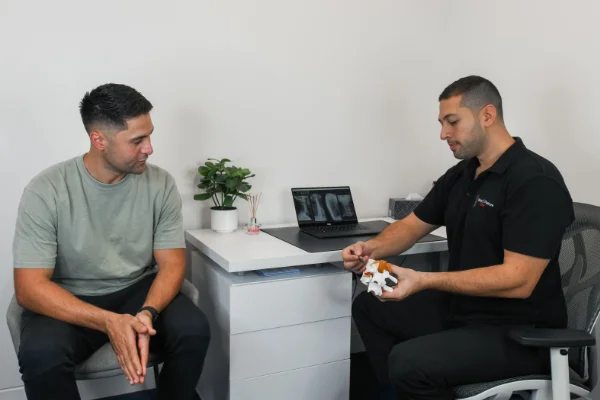
A chiropractor assesses the specific spinal segments that are loaded and restricted. They identify whether the disc, facet joints, or surrounding musculature is the primary source. A care plan then addresses the cause rather than just the symptom. For Sydney commuters, that assessment also looks at the full daily loading picture: the desk setup, the sleep posture, and the commute pattern. The driving pain is rarely the only contributor.
Back pain after the commute is not something to push through. Spine and Posture Care offers a new patient special at both the Macquarie Street and Barangaroo clinics in Sydney CBD. Call (02) 8040 9922 or book a new patient appointment online today. Same-week appointments are available Monday to Saturday.
Five Things to Do Before and After Every Sydney Commute
These five steps take under ten minutes combined. They address the specific loading patterns that Sydney’s stop-start traffic creates.
Before driving, spend two minutes doing a hip flexor stretch on each side. Stand in a split stance, lower the back knee toward the ground, and hold for 30 to 45 seconds per side. This restores hip flexor length before the commute shortens it again and reduces the anterior pelvic tilt that loads the lumbar spine during and after the drive.
Before driving, check and set the seat position using the table in Section 4. Adjust the lumbar support, confirm the seat distance, and remove anything from the back pockets. This takes under 60 seconds and immediately reduces the postural load of the commute.
During the commute, release the grip on the steering wheel at every red light or standstill. Let the hands rest loosely, roll the shoulders back gently, and take one slow breath. This interrupts the accumulated bracing cycle and reduces upper back and neck tension.
After driving, do not walk straight from the car to a desk. Spend two to three minutes walking at a natural pace before sitting again. This allows the hip flexors to return toward a neutral length, restores some lumbar curve, and transitions the spine from one sustained load into a slightly different one rather than compounding the same pattern.
After the workday commute home, a five-minute standing or gentle walking period before sitting on the couch or at the dinner table applies the same principle. The spine needs some extension-based movement after ten-plus hours of flexion-dominant loading. Even standing and gently arching the lower back five to ten times activates the muscles that have been passive all day.
Conclusion: Your Back Pain After Driving in Sydney Is Not Inevitable
Back pain after driving in Sydney traffic is common but it is not simply the price of living in a congested city. It has specific biomechanical causes, specific aggravating factors, and specific solutions. The stop-start nature of Sydney’s peak-hour traffic creates a loading pattern that is more demanding on the lumbar spine than most people realise. The combination of disc pressure, hip flexor shortening, repetitive bracing, poor seat setup, and a full day of desk posture stacks cumulative load that the spine eventually signals through pain.
The guide on how driving affects spinal health and core strength covers the connection between the spine and the core muscles that support it, which is the next layer of this problem for anyone whose back pain persists despite postural changes. Spine and Posture Care provides initial assessments at Macquarie Street and Barangaroo in Sydney CBD, with appointments available Monday to Saturday.
Spine and Posture Care is located at 139 Macquarie Street Sydney CBD and Level 35, 100 Barangaroo Avenue. Call (02) 8040 9922 to speak with a chiropractor, or Book Online to secure a same-week appointment. The new patient assessment includes a full spinal examination, posture analysis, and a clear diagnosis before any treatment begins.
Frequently Asked Questions
1. Why does my lower back hurt specifically after driving in Sydney traffic but not on weekend drives?
The difference comes down to the type of driving rather than the duration. Sydney peak-hour traffic is characterised by constant braking, accelerating, lane changes, and sustained low-speed tension. Each braking event triggers a low-grade muscular bracing response in the paraspinal muscles. Each lane change or merge creates a rotational micro-load through the lumbar spine. These events happen dozens of times in a typical peak-hour commute through the CBD or along corridors like Parramatta Road, Military Road, or the Pacific Highway. On a weekend drive, even a long one, the body maintains a more consistent position at a steadier speed. The stabilising muscles find a holding pattern and maintain it. In stop-start traffic they never can. The cumulative effect of repeated bracing and position changes across 45 minutes of peak-hour driving creates a muscular fatigue and disc load that a two-hour motorway drive does not. Adding to this, the stress of peak-hour driving increases overall muscle tone through cortisol and adrenaline release, making the paraspinal muscles work harder than they would in a relaxed driving environment.
2. How long does it take for driving-related back pain to become a chronic problem?
The transition from acute to chronic back pain is generally described in clinical terms as pain persisting beyond 12 weeks. For Sydney commuters who drive daily without addressing the contributing factors, that threshold can be reached within three to four months of the pain first appearing. The pattern is typically gradual. The pain starts as post-commute soreness that resolves overnight. Over weeks it starts taking longer to settle. Eventually it is present in the mornings before the commute begins. By that point the nervous system has begun to sensitise to the pattern and the pain is no longer purely a mechanical response to load but also a neurological one. Early assessment and intervention breaks this pattern before it becomes established. The research is consistent that people who seek assessment and active management of back pain early recover faster and are less likely to develop chronic pain than those who wait and manage with rest alone.
3. Can a lumbar support cushion fix back pain from driving in Sydney?
A lumbar support cushion helps and it should be used, but it is rarely sufficient on its own. The cushion addresses one contributor, the loss of lumbar curve in a poorly supported seat, but Sydney commuter back pain typically has several concurrent causes. The repetitive bracing reflex, hip flexor shortening, pelvic tilt from a wallet in the back pocket, grip tension, and the compounding effect of desk posture throughout the day all continue regardless of lumbar support. A well-fitted lumbar cushion reduces disc pressure and maintains the lower back curve during the drive. For a driver with otherwise good spinal health and a well-set seat position, it may be enough to prevent symptoms. For a driver who already has persistent post-commute pain, it reduces one load in a system carrying several. The seat setup checklist in this guide covers the full range of adjustments that work together with lumbar support to reduce overall spinal loading during the commute.
4. Why does my back hurt more after a 30-minute Sydney commute than after a 2-hour road trip?
This is one of the most common observations Sydney commuters make when they first present with driving-related back pain, and the answer lies in the mechanics of the driving environment rather than the time spent in the car. A 30-minute Sydney peak-hour commute on Parramatta Road or through the CBD involves far more braking events, acceleration cycles, steering corrections, and stress responses than a 2-hour motorway drive. Each of these events loads the lumbar spine in a way that steady-speed driving does not. The bracing reflex fires repeatedly. The paraspinal muscles never fully release between events. The hip flexors contract and hold through dozens of slow-speed stop-start cycles. On a motorway, the body finds a consistent position and maintains it. Muscle fatigue from a consistent load is different from muscle fatigue from repeated asymmetric loading events. Sydney stop-start traffic creates the latter, and it is significantly more demanding on the lumbar spine per unit of time than open-road driving.
5. Is the back pain I get from driving in Sydney a sign of a bulging disc?
It may be, but it is not possible to determine this from symptoms alone. Muscular back pain, facet joint irritation, and disc-related pain can all present as post-commute lower back soreness with similar characteristics in the early stages. The signs that suggest disc involvement rather than purely muscular pain include pain that radiates into the buttock or down the leg, pain that is worse when sitting and improves when standing or walking, pain that increases with coughing or sneezing, and pain that is accompanied by any numbness or tingling in the leg or foot. Disc-related pain also tends to be more persistent and slower to settle than muscular pain. If the back pain after driving resolves fully after a night of sleep and is limited to the lower back without any leg symptoms, a purely muscular or facet joint cause is more likely. If any of the features above are present, a clinical assessment is necessary to determine whether disc involvement is contributing and what the appropriate management should be.
6. Does chiropractic care actually help with back pain caused by driving?
Yes, and the mechanism is well understood. Chiropractic care for driving-related back pain addresses the specific spinal segments that have become restricted or irritated through the repeated loading of the commute. Spinal adjustments restore movement to those segments, which reduces the compensatory muscle guarding that builds up around them. Soft tissue work reduces the muscular tension in the paraspinals, hip flexors, and gluteal muscles that have been loaded and shortened through the commute and workday. Rehabilitation exercises address the core stability deficit that allows the lumbar spine to be passively loaded in the first place, making the spine more resilient to future commuting stress. For Sydney CBD commuters, the chiropractor also assesses the full daily loading picture and can give specific guidance on seat setup, desk ergonomics, and movement habits that reduce the overall load the spine is managing. The combination of hands-on care and practical daily changes consistently produces better outcomes for driving-related back pain than passive rest or pain management alone.