

Years of desk work, phone use, and commuting leave a mark on the spine that trying harder to sit up straight does not fix. Posture Correction Sydney is one of the most common reasons adults present to Spine and Posture Care in Sydney CBD, many having already tried reminders, braces, and stretching with no lasting result.
This guide explains what the science actually says about reversing bad posture as an adult, and what a structured correction programme involves.
Bad Posture Is Not a Habit Problem, It Is a Neuromuscular One
Bad posture in adults is not primarily a matter of effort or awareness. The deeper cause is a shift in how the neuromuscular system has learned to hold the body upright over years of repeated positions.
The body learns movement and postural patterns through a process called motor learning. When a position such as sitting with the head forward and shoulders rounded is repeated thousands of times over months and years, the nervous system encodes it as the default. The superficial muscles that were never designed for sustained postural work take over and fatigue quickly, producing the aching and stiffness most adults associate with poor posture.
Simultaneously, the spinal joints in the thoracic and cervical spine gradually lose range of motion from sustained compression and lack of movement through their full range. Restricted joints cannot move into alignment even when the muscles attempt to hold the body upright. This is why simply trying to sit up straight feels effortful and unsustainable. The mechanical restriction in the joints prevents it from feeling natural.
Bad Posture Can Be Reversed in Adults and Here Is What the Research Shows
Yes. The research is clear that postural patterns established over years can be changed in adults, though the process requires more than passive correction. The key principle from motor learning research is that the nervous system retains plasticity throughout adult life. New movement patterns can be established at any age provided the right stimulus is applied consistently and the underlying mechanical restrictions are addressed.
The distinction that matters is between structural changes and functional changes. Structural changes, such as degenerative disc changes, significant kyphotic curvature from long-standing compression, or Scheuermann’s disease, place limits on how much correction is achievable. Functional changes, including muscle weakness, joint restriction, and habitual motor patterns, are all fully reversible. The vast majority of adults presenting with poor posture have predominantly functional changes, not structural ones.
For a thorough overview of what posture and spinal health research shows about long-term outcomes, the clinical evidence consistently supports structured intervention over passive observation. Adults in their 40s, 50s, and 60s who undertake a structured posture correction programme show meaningful improvements in spinal alignment, pain levels, and functional capacity when the programme addresses both the mechanical restrictions and the muscular re-education components together.
How Long Does Posture Correction Actually Take for Adults
Timeline expectations are one of the most important things to establish before beginning any posture correction programme. Unrealistic expectations in either direction, expecting change in two weeks or assuming nothing can change, are both obstacles to successful outcomes.
Functional improvement in pain, stiffness, and comfort typically begins within four to eight weeks of consistent treatment and exercise. Patients notice that sustained positions feel less effortful, that the urge to slump returns less quickly, and that morning stiffness reduces. These changes reflect early neuromuscular adaptation. The nervous system is beginning to accept the new pattern as a viable default.
Structural re-education, where the joints have regained full range of motion and the postural pattern is maintained through daily activities without reminders, typically takes three to six months. The timeline is influenced by how long the postural pattern has been established, whether joint restriction is present and how many segments are affected, the consistency of the home exercise programme, and how much the daily environment reinforces the old pattern.

What Years of Poor Posture Actually Do to Your Neck
Forward head posture is the cervical component of poor postural alignment and it has a measurable mechanical effect on the neck. For every centimetre the head shifts forward of the shoulders, the load on the cervical spine increases significantly. At a 45-degree forward tilt, the effective weight of the head on the cervical joints reaches over 20 kilograms, compared to approximately 5.5 kilograms in neutral alignment.
The sustained compression and restriction that results from this forward position affects the upper cervical joints at C1 to C3 in particular. These joints share a nerve communication pathway with the trigeminal nerve, meaning restriction in this region refers to pain forward to the head and produces cervicogenic headache alongside neck pain. The deep neck flexor muscles that are designed to maintain cervical alignment progressively weaken through disuse as the forward head position becomes habitual.
Patients presenting to Spine and Posture Care with chronic neck pain, frequent headaches, and upper trapezius tension almost always have a forward head posture component that drives all three symptoms. Treating the neck in isolation without correcting the postural driver produces only partial and temporary improvement.
What Years of Poor Posture Actually Do to Your Back
The thoracic and lumbar spine bear the compressive load that follows from altered postural alignment. When the head moves forward and the shoulders round, the thoracic spine increases its kyphotic curve and the lumbar spine either flattens or hyperextends to compensate. Neither compensatory pattern is load-neutral. Both increase pressure on the intervertebral discs and facet joints beyond their intended load capacity.
The lumbar compensation pattern is the most clinically significant for lower back pain presentations. A flattened lumbar curve removes the natural load-distribution function of the lumbar lordosis, concentrating stress on the posterior disc and facet joints. A hyperextended compensation pattern overloads the lumbar facet joints directly. Both patterns contribute to the chronic low-grade lower back pain and end-of-day fatigue that desk workers in Sydney CBD consistently describe.
The thoracic spine is the segment most commonly overlooked in postural correction programmes. Thoracic joint restriction is both a consequence of sustained flexed posture and a mechanical barrier to correction. Addressing thoracic mobility is a prerequisite for achieving lasting improvement in cervical and lumbar alignment. The segments above and below cannot hold a corrected position when the middle of the spine is immobile.
Why Desk Work and Screen Time Make Posture Worse Over Time
The relationship between screen use and postural collapse is now one of the most documented areas of musculoskeletal research. The modern Sydney CBD work pattern of eight or more hours daily at a computer, followed by several hours of phone and tablet use, creates a cumulative postural load that the spine was not designed to sustain.
The specific problem is not simply the number of hours but the static nature of the position. When the body holds a sustained posture, the deep stabilising muscles fatigue and disengage progressively. The postural load shifts to passive structures, including ligaments, joint capsules, and discs, which are not designed for sustained load-bearing. Over months and years, this pattern progressively reshapes the resting position of the spine toward the held posture.
Understanding tech neck, the cervical manifestation of screen-related postural collapse, explains why so many Sydney CBD desk workers present with both neck and lower back symptoms simultaneously. The postural chain from the cervical spine to the lumbar spine is connected, and the screen-driven forward head position at the top of the chain affects every segment below it.
Why Stretching Alone Is Not Enough to Fix Bad Posture
Stretching is the most commonly recommended self-management strategy for poor posture and the one with the least standalone evidence for lasting change. The reason is mechanical: stretching addresses muscles that have shortened and tightened through sustained posture, but it does not address the muscles that have weakened and lengthened.
The deep stabilising muscles, including the deep neck flexors, lower and middle trapezius, deep lumbar multifidus, and transversus abdominis, become progressively inhibited through disuse in poor postural positions. These muscles do not respond to passive stretching because they are not tight. They respond to progressive loading through specific activation exercises that target the motor pattern directly.
A posture correction programme that consists only of chest-opener stretches and upper trapezius releases will produce temporary symptomatic relief without changing the underlying weakness pattern. Within days of stopping the stretching routine, the tightness returns. The muscles causing the tightness are compensating for the weakness underneath, not simply overworked in isolation.
Posture that keeps reverting despite consistent effort is a sign the underlying restriction has not been addressed. Spine and Posture Care provides postural assessments across both Sydney CBD locations at Macquarie Street and Barangaroo Avenue. Call +61 2 8040 9922 or contact us to arrange an assessment today.
The 4 Things That Actually Produce Lasting Posture Change
Research and clinical practice consistently identify four components that produce lasting postural change when applied together. Missing any one of them is the most common reason posture correction programmes produce only partial results.
- Spinal joint mobilisation to restore restricted segments
Joint restriction in the thoracic and cervical spine prevents the body from holding a corrected posture even when the muscles attempt it. Specific chiropractic adjustment to restricted segments restores the mechanical range of motion that makes correct alignment accessible. Without this, exercise programmes target muscles that are working against an immovable mechanical barrier.
- Deep stabiliser activation and progressive loading
The deep neck flexors, lower trapezius, multifidus, and transversus abdominis are the muscles that actually hold posture through daily activity. They respond to specific low-load activation exercises that teach the nervous system to recruit them reliably. Progressive loading over weeks and months builds the endurance capacity required for sustained postural support through a full working day.
- Motor pattern re-education through repetition
Changing a postural pattern requires replacing the existing motor programme with a new one through repetition. This is the neuroplasticity component. The nervous system encodes the corrected position as the new default. It requires consistent daily practice of the correct position across multiple contexts, not just during exercise sessions.
- Environmental modification
The daily environment reinforces the old postural pattern for eight or more hours a day. Screen height, chair setup, commuting posture, and phone holding habits all feed back into the pattern the nervous system is being asked to replace. Environmental changes that reduce the compressive load of the old pattern allow the new pattern to consolidate faster.
| Comparison Criteria | Self-Management | Professional Posture Correction at Spine and Posture Care |
|---|---|---|
| Addresses joint restriction | No | Yes: specific assessment and adjustment |
| Targets deep stabilisers | Partially: generic exercises | Yes: prescribed to each patient’s pattern |
| Motor re-education | Limited: no external feedback | Yes: guided and progressed across sessions |
| Environmental assessment | Self-directed | Yes: workstation and lifestyle review |
| Identifies structural vs. functional limits | No | Yes: full assessment before treatment |
| Timeline to lasting change | Unpredictable | 3 to 6 months with structured programme |
What Posture Correction Looks Like at Spine and Posture Care
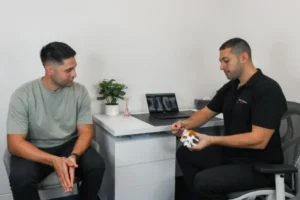
The posture correction process at Spine and Posture Care as a Sydney chiropractor begins with a full postural and spinal assessment before any treatment is applied. The assessment covers standing and seated postural analysis, cervical and thoracic range of motion testing, deep stabiliser muscle assessment, and identification of restricted spinal segments in the thoracic, cervical, and lumbar spine.
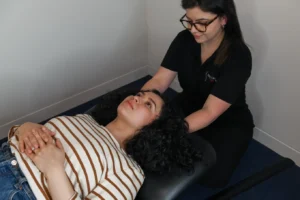
The findings determine the treatment approach. For most adults with long-standing poor posture, the first priority is restoring restricted joint mobility in the thoracic spine. This is the mechanical prerequisite for everything that follows. Specific chiropractic adjustments are applied to the segments with the greatest restriction, followed by soft tissue work to the muscles that have compensated and tightened around those restrictions.
The exercise prescription is built from the assessment findings rather than from a generic posture programme. Deep neck flexor activation, lower and middle trapezius loading, thoracic extension work, and lumbar stabilisation exercises are prescribed and progressed based on what each patient’s neuromuscular assessment identifies as weak. Patients leave each session with a clear home programme that builds toward independent postural maintenance. Progress is reviewed systematically across the care plan, with adjustments made as joint mobility improves and deep stabiliser capacity develops.
Daily Habits That Speed Up Your Posture Correction Progress
The rate of improvement in any posture correction programme depends significantly on how much the daily environment works with the treatment or against it. Several daily habits consistently accelerate progress for Spine and Posture Care patients.
Raising the screen to eye level is the single most impactful environmental change for desk workers. It eliminates the sustained forward head angle that drives the cervical component of postural collapse for the majority of working hours. A monitor stand or laptop riser that positions the top of the screen at eye height removes the daily compressive load before it accumulates.
Taking a movement break every 45 minutes interrupts the static loading pattern that fatigues deep stabilisers and shifts load to passive structures. A two-minute break involving standing, walking, or a brief thoracic extension is more effective than a longer break taken less frequently. The goal is to prevent the deep stabilisers from disengaging entirely rather than recovering after they already have.
Practising chin tucks daily targets the deep neck flexors directly. Ten repetitions performed three times a day, drawing the chin straight back to create a brief double-chin position, activates the muscle group that sustained forward head posture most specifically inhibits. This simple exercise, done consistently, accelerates the cervical component of postural re-education faster than any passive treatment alone.
Conclusion
Bad posture in adults is not a permanent condition and it is not simply a matter of trying harder. The science of motor learning and neuroplasticity is clear: postural patterns established over years can be changed through a structured programme that addresses the mechanical restrictions, rebuilds the inhibited deep stabilisers, and replaces the encoded motor pattern through consistent repetition. What does not work is passive stretching, reminder-based correction, or any approach that treats posture as a conscious effort rather than an automatic neuromuscular programme.
Spine and Posture Care works with adults across Sydney CBD who have been dealing with the consequences of long-standing poor posture: chronic neck and lower back pain, frequent headaches, and the daily fatigue of a spine working inefficiently. The posture correction process starts with identifying exactly what has changed mechanically and building the programme from that assessment rather than applying a generic protocol.
Ready to Get Started? Posture correction that produces lasting change starts with an accurate assessment. Spine and Posture Care is available at Macquarie Street and Barangaroo Avenue in Sydney CBD. Call +61 2 8040 9922 or book through the new patient offer
today.
Frequently Asked Questions
Can bad posture really be fixed after years of sitting incorrectly?
Yes. Most adults have functional changes, including muscle weakness, joint restriction, and habitual motor patterns, rather than structural damage. Functional changes are fully reversible at any age with a programme that addresses joint mobility, deep stabiliser activation, and motor re-education together.
Why does my posture keep reverting even when I try to sit up straight?
The most common reason is restricted thoracic joints that physically prevent correct alignment. The deep stabilising muscles have also become inhibited through disuse. Until both are addressed, postural correction relies entirely on conscious effort and reverts the moment attention shifts.
What is the difference between postural correction through chiropractic and physiotherapy?
Chiropractic addresses joint restriction directly through spinal adjustment, which exercise alone cannot do. Restricted joints are a mechanical barrier to postural change regardless of muscle strength. A combined approach that restores mobility first and builds the muscular programme on top produces consistently better outcomes.
How many sessions does posture correction typically take?
Most patients see initial improvement within four to six sessions. A standard care plan at Spine and Posture Care spans eight to twelve weeks of active treatment, followed by periodic maintenance. Patients who apply the home exercise programme consistently between sessions progress significantly faster.
Does poor posture cause headaches, and will correcting posture reduce them?
Yes. Restricted joints at C1 to C3 refer pain forward through the trigeminal nerve, producing cervicogenic headache. This is a direct consequence of forward head posture. Restoring upper cervical mobility and rebuilding deep neck flexor support consistently reduces both headache frequency and severity.